Industrial facilities depend on automation systems to maintain stable production, protect equipment, support operators, and keep critical processes functioning as intended. When those systems become unreliable, poorly documented, obsolete, or difficult to support, the consequences can extend far beyond the control room.
Production interruptions, recurring alarms, inconsistent process performance, unavailable replacement parts, and delayed projects are often treated as isolated problems. In reality, they may indicate a larger control system issue that requires experienced, independent engineering support.
Industrial automation consulting gives plant owners and engineering teams access to specialized expertise without requiring them to add permanent internal resources. The right consultant can assess existing systems, identify technical and operational risks, develop practical recommendations, and help implement improvements across DCS, PLC, HMI, SCADA, instrumentation, and related process control environments.
The question is not whether outside expertise can help. The real question is when your facility has reached the point where continuing without it creates unnecessary risk.
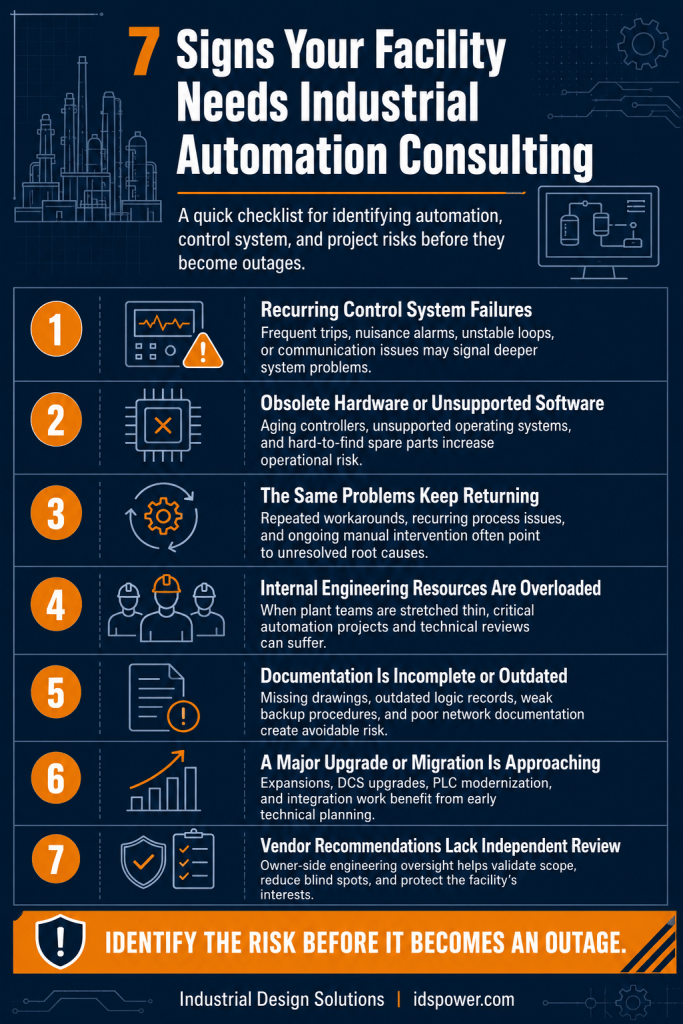
Here are seven signs that it may be time to engage an industrial automation consulting firm.
What Is Industrial Automation Consulting?
Industrial automation consulting is a specialized engineering service focused on evaluating, designing, improving, troubleshooting, modernizing, and supporting industrial control systems.
Unlike a general business consultant, an industrial automation consultant works directly with the systems responsible for monitoring and controlling physical processes. These may include:
- Distributed Control Systems (DCS)
- Programmable Logic Controllers (PLC)
- Human-Machine Interfaces (HMI)
- Supervisory Control and Data Acquisition systems (SCADA)
- Instrumentation and field devices
- Process control networks
- Alarm management systems
- Control logic and operator graphics
- Safety and burner management systems
- Historical data and reporting platforms
1. Your Control System Has Become Increasingly Unreliable
Occasional equipment issues are expected in any industrial environment. A pattern of unexplained trips, communication failures, controller problems, unreliable graphics, nuisance alarms, or recurring process interruptions is different.
These symptoms can indicate deeper problems involving:
- Aging hardware
- Degraded network infrastructure
- Inconsistent control logic
- Improper system configuration
- Unsupported software
- Poorly maintained databases
- Undocumented modifications
- Inadequate alarm rationalization
- Process strategies that no longer match current operations
Repeatedly correcting the immediate symptom without investigating the underlying system allows risk to accumulate.
An industrial automation consultant can review system performance, maintenance history, alarm behavior, control logic, network architecture, and operator feedback to identify patterns that may not be visible when each incident is handled independently.
The objective is not simply to restore operation after another failure. It is to determine why the failures continue and develop a practical plan for improving long-term reliability.
2. Critical Hardware or Software Is Obsolete
Industrial control systems often remain in service for decades. Long operating life can be an advantage, but it also creates significant lifecycle challenges.
A system may still be functioning while depending on:
- Discontinued controllers
- Unsupported operating systems
- Obsolete communication modules
- Unavailable replacement parts
- Aging workstations
- Unsupported application software
- Proprietary components with limited vendor support
- A shrinking pool of qualified technicians
Obsolescence does not automatically mean that the entire system must be replaced immediately. It does mean the facility needs a documented lifecycle strategy.
A qualified automation engineering consultant can help determine:
- Which components present the greatest operational risk
- Whether replacement parts remain realistically obtainable
- Which systems can be maintained safely
- Where targeted upgrades are sufficient
- Whether a phased migration is practical
- What should be addressed during the next scheduled outage
- Which dependencies could complicate modernization
IDS supports engineering, integration, migration, and lifecycle planning across leading DCS and PLC platforms, including modern and legacy control environments.
A proactive assessment gives the plant time to make informed decisions. Waiting until a critical component fails removes that advantage and can force the facility into an expensive emergency response.
3. Your Team Is Solving the Same Problems Repeatedly
A recurring control problem is rarely just an inconvenience. It consumes engineering time, distracts maintenance personnel, frustrates operators, and creates avoidable production risk.
Common examples include:
- A loop that repeatedly becomes unstable
- An alarm that operators routinely ignore
- A sequence that requires manual intervention
- A controller that must be restarted
- A communication failure that temporarily disappears after a reset
- A production constraint that no one can fully explain
- A workaround that has become part of normal operation
Workarounds are sometimes necessary to keep production moving. They become dangerous when temporary measures turn into permanent operating procedures.
Process automation consulting introduces an outside technical perspective. An experienced consultant can evaluate the interaction between control strategies, equipment behavior, instrumentation, operator actions, and process conditions.
This broader review is often necessary because the visible control system symptom may not be the actual root cause.
For example, inconsistent process performance could result from faulty instrumentation, poor tuning, incorrect logic, mechanical limitations, communication delays, or a control strategy that no longer reflects how the plant operates.
IDS provides control engineering services for both straightforward and complex process control strategies in industrial and power-generation environments.
4. Your Internal Engineering Team Does Not Have Enough Capacity
Many facilities have capable internal engineering and maintenance teams. The problem is not always a lack of competence. It is often a lack of available time.
Internal personnel may already be responsible for:
- Daily production support
- Maintenance planning
- Regulatory requirements
- Capital projects
- Outage preparation
- Vendor coordination
- Cybersecurity initiatives
- Instrumentation issues
- System backups
- Documentation
- Operator support
A major automation project can require hundreds or thousands of additional engineering hours. Assigning that workload to an already stretched internal team increases the likelihood of missed requirements, rushed reviews, incomplete documentation, and avoidable project delays.
Industrial automation consulting provides additional capacity without removing control from the plant team.
The consultant can handle defined technical responsibilities such as:
- Existing-system assessments
- Functional requirements development
- Control narrative preparation
- Logic and graphics review
- Vendor proposal evaluation
- System architecture review
- Migration planning
- Testing support
- Commissioning preparation
- Project documentation
- Independent technical oversight
This allows internal personnel to remain focused on plant priorities while still participating in the decisions that affect operations.
5. Your Control System Documentation Is Incomplete or Outdated
Control system documentation should explain how the system is designed, configured, operated, maintained, and recovered. In many facilities, it does not.
Documentation gaps commonly develop after years of expansions, emergency modifications, personnel changes, vendor projects, and undocumented field work.
The facility may discover that:
- Drawings no longer match the installed system
- Logic changes were never documented
- Control narratives are missing
- Network diagrams are outdated
- Backup procedures are unclear
- Alarm philosophy documents do not exist
- Original design assumptions are unknown
- Only one employee understands a critical sequence
- Vendor files are incomplete or inaccessible
This creates a serious dependency on tribal knowledge.
When experienced employees retire, leave the company, or become unavailable, the facility can lose information that is essential to safe and reliable operation.
An automation consultant can help reconstruct the current system, identify documentation gaps, verify configurations, and establish a controlled set of usable engineering records.
Documentation should not be produced solely to satisfy a project deliverable. It should help engineers troubleshoot, help operators understand system behavior, support maintenance planning, and reduce the time required to recover from a failure.
6. You Are Planning an Expansion, Upgrade, or DCS Migration
Automation decisions made during the early stages of a project can determine whether the resulting system is maintainable, scalable, and aligned with the plant’s actual requirements.
Facilities often involve automation engineers too late—after equipment has been selected, scope has been defined, or vendor commitments have already been made.
That creates problems when:
- The proposed architecture does not integrate cleanly with existing systems
- The vendor scope excludes important engineering work
- Operator requirements have not been documented
- Existing logic must be converted without adequate review
- Testing requirements are incomplete
- The outage schedule is unrealistic
- Cybersecurity responsibilities are unclear
- Data migration has been underestimated
- Interfaces with package equipment are poorly defined
- The new system duplicates old problems instead of correcting them
Independent industrial automation consulting is especially valuable before the facility approves a major scope of work.
A consultant can evaluate the current environment, define project requirements, identify dependencies, compare technical approaches, review vendor proposals, and help the plant develop a phased implementation strategy.
For DCS projects, IDS also provides Owner’s Engineering and independent site representation. This gives plant owners an experienced technical advocate who can review OEM scope, logic, graphics, system design, testing, and deliverables on the owner’s behalf.
When modernization is necessary, the decision should not begin with a product. It should begin with the operational requirements, lifecycle risks, project constraints, and long-term objectives of the facility.
7. You Are Relying Entirely on a Single Vendor’s Recommendation
Original equipment manufacturers and system vendors are important project partners. They also approach projects from the perspective of their own products, services, commercial model, and available resources.
That does not make their recommendations wrong. It does mean the plant should understand whether the recommendation represents the best solution for the facility or simply the vendor’s preferred solution.
Independent automation consulting can help the plant evaluate:
- Whether the proposed scope is complete
- Whether all necessary engineering tasks are included
- Whether the architecture supports long-term objectives
- Whether proposed hardware is appropriate
- Whether migration assumptions are realistic
- Whether testing requirements are adequate
- Whether the project schedule is achievable
- Whether quoted services are necessary and fairly defined
- Whether the solution creates avoidable vendor dependency
- Whether lower-risk alternatives exist
The goal is not to create conflict with the OEM. The goal is to ensure the facility has its own informed technical representation.
An independent consultant should be able to challenge assumptions, identify omissions, explain tradeoffs, and protect the plant’s operational interests throughout the project.
What Should an Industrial Automation Consultant Evaluate?
The exact scope depends on the facility and the problem being addressed. A meaningful initial assessment will often examine several connected areas rather than focusing on one isolated component.
Control System Architecture
The consultant should review controllers, servers, operator stations, networks, communication paths, remote access, interfaces, redundancy, and relationships between DCS, PLC, SCADA, and package systems.
Hardware and Software Lifecycle
The review should identify unsupported components, aging infrastructure, software dependencies, licensing concerns, replacement-part availability, and systems approaching end of life.
Process Control Performance
This may include control strategy effectiveness, loop performance, sequence behavior, tuning, alarm activity, operator intervention, production constraints, and recurring process deviations.
Documentation and Change Management
The consultant should determine whether drawings, logic documentation, control narratives, network diagrams, backups, and configuration records accurately represent the installed system.
Operational Technology Security
Industrial automation systems must be evaluated with their unique safety, reliability, and operational requirements in mind. The National Institute of Standards and Technology addresses those characteristics in its Guide to Operational Technology Security.
The ISA/IEC 62443 series of standards also provides a lifecycle-based framework for securing industrial automation and control systems.
Automation consultants do not replace qualified cybersecurity specialists. However, control system engineering decisions should account for network segmentation, remote access, system hardening, account management, patching constraints, backups, recovery requirements, and secure system architecture.
Project and Operational Risk
The assessment should identify what could interrupt production, delay a project, increase maintenance dependency, compromise recoverability, or prevent the facility from meeting future operating requirements.
How to Choose an Industrial Automation Consulting Firm
Not every consultant is qualified to work in a mission-critical process control environment. Look for a firm with demonstrated experience in the systems, industries, and project types relevant to your facility.
The consulting team should be able to:
- Understand both legacy and current control platforms
- Communicate directly with plant personnel
- Work independently of a single manufacturer
- Explain technical risks in practical operational terms
- Provide engineering support beyond a written assessment
- Review logic, graphics, architecture, and documentation
- Support testing, implementation, and commissioning
- Work effectively with OEMs and other contractors
- Develop recommendations that fit realistic outage and budget constraints
- Provide clear ownership and accountability
Avoid firms that begin recommending products before understanding the problem.
A credible industrial automation consultant should first evaluate the facility’s objectives, existing environment, technical constraints, operational risks, and internal capabilities.
Why Facilities Choose IDS for Industrial Automation Consulting
Industrial Design Solutions is a U.S.-based engineering firm and advanced solutions provider specializing in industrial process control systems.
IDS supports mission-critical facilities across Honeywell, Emerson, DeltaV, Ovation, and legacy DCS environments. Its capabilities include:
- Industrial automation consulting
- DCS engineering and support
- Control system design
- PLC engineering
- Process control strategy development
- DCS and PLC modernization
- Migration planning
- Logic and graphics review
- Owner’s Engineering
- System troubleshooting
- Training
- Lifecycle support
- Testing and commissioning assistance
IDS engineers work directly with plant personnel to understand the real operating problem, not merely the immediate technical symptom.
Review selected industrial control system projects completed by IDS to see how the company applies process control and DCS expertise in real industrial environments.
Do Not Wait for a Control System Emergency
The best time to evaluate an industrial automation problem is before it causes an unplanned outage, compromises a major project, or forces the facility into an emergency purchasing decision.
Recurring failures, obsolete components, undocumented systems, limited internal capacity, and poorly defined modernization plans are not isolated inconveniences. They are warnings that the facility’s control environment may be accumulating risk.
Industrial automation consulting gives plant owners an opportunity to understand that risk, prioritize the right improvements, and develop a practical path forward.
Industrial Design Solutions provides independent, U.S.-based industrial automation and control system expertise for facilities that need greater reliability, stronger project oversight, or a clear modernization strategy.
Contact Industrial Design Solutions to discuss your control system, DCS, PLC, modernization, troubleshooting, or engineering support requirements.