
If your facility operates under Department of Energy (DOE) oversight, you already know one hard truth:
Nothing is permanent.
Especially approvals, extensions, or timelines.
DOE plant extensions are commonly issued in 90-day intervals, creating a rolling cycle of uncertainty for operations, compliance, and—critically—your control systems. Yet many plants are still locked into annual OEM support contracts that don’t align with how DOE oversight actually works.
There’s a smarter, more flexible option.
The Reality of 90-Day DOE Plant Extensions
DOE-regulated plants often operate in a state of conditional approval. Extensions are granted in short, controlled windows—typically every 90 days—allowing continued operation while remediation, modernization, or compliance activities move forward.
From an operational standpoint, this creates a unique challenge:
- You must remain fully operational
- You must minimize risk to safety and production
- You must avoid long-term commitments that may not be needed
- You must be ready to pivot—fast
What doesn’t change during these extensions is your reliance on a stable, supported Distributed Control System (DCS).
And that’s where many plants get stuck.
The Problem with Traditional OEM Support Contracts
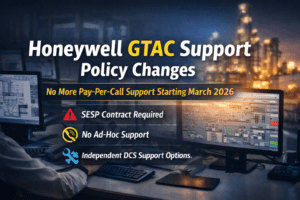
OEM support contracts are typically sold as 12-month (or longer) commitments, regardless of how long your plant is approved to operate. While OEMs play an important role, their support models often create friction in DOE extension scenarios.
Common challenges include:
- Paying for a full year when you may only need 90 days
- Lengthy contract approval and procurement cycles
- Limited flexibility for legacy or hybrid control systems
- High cost, even when actual support usage is minimal
- Support models designed for steady-state operation—not conditional approval
For facilities operating extension to extension, this mismatch often means overpaying for coverage you may never use, or delaying support decisions and increasing operational risk.
Why DCS Support Still Matters During Extensions
Even during temporary or conditional operation, your DCS remains mission-critical.
Loss of control system support can lead to:
- Extended downtime during system faults or failures
- Slower troubleshooting and recovery
- Increased operational and safety risk
- Compliance exposure
- Escalating costs during emergency response
In short, “temporary” operation does not mean “temporary risk.”
Your plant still needs expert-level DCS support—it just doesn’t need to be locked into a long-term contract.
IDS 90-Day DCS Support Contracts—Built for Extension-Based Operation
IDS offers 90-day DCS support contracts specifically designed to align with DOE plant extension cycles.
Instead of forcing your facility into an annual OEM agreement, IDS provides short-term, renewable support coverage that matches how your plant is actually operating.
What IDS 90-Day Support Delivers
- Support coverage aligned directly to DOE extension periods
- OEM-agnostic expertise across major DCS platforms
- Proven experience supporting legacy systems
- Faster response without contract overhead
- Predictable costs with no long-term commitment
When your plant receives a 90-day extension, IDS support can be activated for that same window—no excess, no waste.
If your extension renews, your support can renew with it.
A Practical Alternative to OEM Dependency
IDS doesn’t replace OEMs—we complement them, and when necessary, provide an alternative when OEM support is impractical, unavailable, or cost-prohibitive.
This approach is especially valuable when:
- Your facility is running legacy DCS hardware or software
- OEM support costs outweigh the duration of the extension
- You need experienced engineers who can engage immediately
- Continuity is required without renegotiating contracts every quarter
For many DOE-regulated facilities, IDS becomes the bridge that keeps operations stable until long-term decisions—such as upgrades, migrations, or decommissioning—are finalized.
Designed for Uncertainty, Built for Reliability
DOE extension cycles introduce uncertainty. Your control system support strategy shouldn’t add to it.
IDS 90-day DCS support contracts are designed to:
- Reduce financial exposure
- Maintain operational continuity
- Support compliance-driven operation
- Give plant leadership flexibility and control
Whether your extension lasts one cycle or several, IDS scales with you.
Keep Your DCS Running—Without Overcommitting
If your facility is operating under DOE extensions and struggling to justify long-term OEM contracts, it may be time to rethink how you approach DCS support.
IDS offers a practical, extension-aligned alternative—so your plant can keep running safely, reliably, and cost-effectively, no matter what the next 90 days bring.
Talk to IDS about 90-day DCS support coverage and make your control system strategy match the reality of DOE operations.