
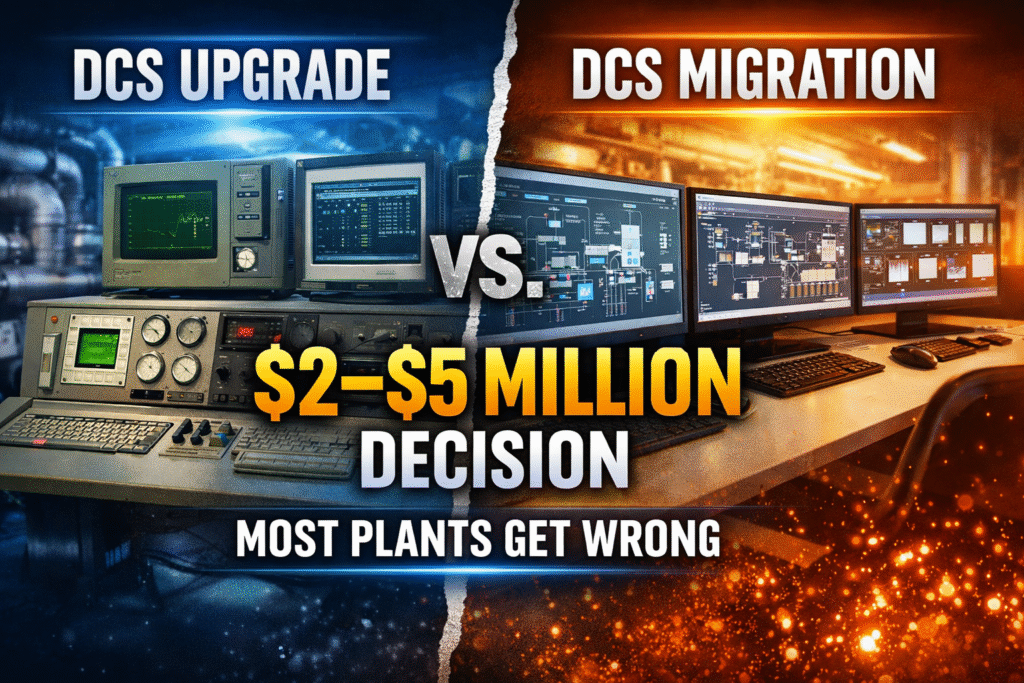
Why Many Plants Delay a DCS Upgrade — and the Risks of Waiting
Modernizing a Distributed Control System (DCS) is expensive.
Sometimes very expensive.
We’ve worked with facilities where a single decision — upgrade or migrate — carried a price tag in the millions. And in more than a few cases, the wrong call led to unnecessary spending, avoidable downtime, or both.
The tricky part isn’t a lack of options.
It’s that most teams are forced to decide with partial information.
Vendors often push full migrations. Internal teams tend to lean toward what feels safest or most familiar. Somewhere between those two is the actual engineering answer.
This article breaks down the real-world tradeoffs between a DCS upgrade and a DCS migration, based on what we see in the field every day.
What’s the Difference Between a DCS Upgrade and a DCS Migration?
On paper, the difference sounds simple.
In practice, it rarely is.
What a DCS Upgrade Really Means
A DCS upgrade focuses on extending the life of an existing control system by modernizing the components that introduce the most risk — controllers, I/O, servers, operating systems, or software versions — while keeping the core architecture intact.
In most cases, upgrades:
Cost less upfront
Minimize operational disruption
Require little to no operator retraining
Can be phased over time
They’re often the right choice when the process is stable and the system’s weaknesses are well understood.
What a DCS Migration Involves
A DCS migration is a full replacement. New platform. New hardware. New software. New graphics. And often, a meaningful learning curve for operations and maintenance teams.
Migrations typically:
Reset the system lifecycle
Unlock modern functionality and cybersecurity features
Support long-term expansion and integration
They also introduce more short-term risk and require careful planning to avoid downtime.
DCS Upgrade vs. DCS Migration — Side-by-Side Comparison
Here’s how a DCS upgrade and full DCS migration typically compare in real-world projects:
| Factor | DCS Upgrade | DCS Migration |
|---|---|---|
| Upfront Cost | Lower | Higher |
| Project Duration | Weeks to months | Months to years |
| Operational Disruption | Low | Moderate to high |
| Operator Retraining | Minimal | Required |
| Long-Term Lifecycle | Extended | Fully reset |
| Short-Term Risk | Lower | Higher |
| Capital Approval | Easier | More complex |
The Risks Most Teams Don’t See Until It’s Too Late
This is the part that rarely shows up in vendor presentations.
Unsupported Legacy Hardware
We still see critical processes running on hardware that hasn’t been manufactured — or supported — in years. Systems like Honeywell TDC 3000 or early-generation DCS platforms can appear stable right up until they aren’t.
When a failure happens, replacement options are limited and downtime stretches quickly.
“It’s Been Fine So Far”
That sentence usually comes right before a major incident.
Legacy systems don’t always degrade slowly. More often than not, they fail suddenly — taking production, safety, and schedules with them.
Cybersecurity Reality
Most legacy DCS platforms were designed long before cybersecurity became a serious concern. Unsupported operating systems, unpatched vulnerabilities, and flat networks all increase exposure.
At some point, risk mitigation alone isn’t enough.
Tribal Knowledge Walking Out the Door
If only one or two people truly understand the system — and they’re nearing retirement — the system is already fragile.
Modernization isn’t just about hardware. It’s about preserving knowledge.
Vendor-Driven Decisions
We see migrations justified because “the vendor says it’s time.” That’s rarely a sufficient engineering reason on its own.
Good decisions come from understanding risk — not sales timelines.
When a DCS Upgrade Is the Right Call
A DCS upgrade often makes sense when:
The process is stable and well understood
Core architecture is still viable
Downtime tolerance is low
Capital budgets are limited
Operators rely heavily on existing workflows
There’s a long-term modernization plan in place
In these cases, a targeted upgrade can extend system life five to ten years while significantly reducing risk.
When a DCS Migration Becomes Unavoidable
A DCS migration is usually the right move when:
Hardware or software is fully unsupported
Safety or regulatory compliance is at risk
Expansion plans are blocked by legacy limitations
Unplanned downtime is increasing
Cybersecurity vulnerabilities can’t be mitigated
Vendor support has ended
At this point, delaying action often costs more than moving forward.
A Real-World Scenario (Anonymized)
A mid-sized processing facility came to IDS convinced a full DCS migration was inevitable. Spare parts were scarce, and leadership feared a catastrophic failure.
After a detailed engineering assessment, we identified a phased upgrade strategy that:
Removed high-risk components
Improved system reliability
Strengthened cybersecurity
Preserved operator familiarity
The result was millions saved, minimal downtime, and a clear roadmap for future modernization.
The IDS Engineering-First Approach
Industrial Design Solutions is intentionally vendor-agnostic. We don’t push upgrades or migrations — we engineer decisions based on:
Actual system condition
Operational risk
Lifecycle planning
Budget realities
Safety and compliance
Whether the answer is upgrading an existing platform or migrating to something new, the goal is the same: protect uptime, reduce risk, and maximize return on investment.
Before You Spend Millions, Get the Facts
Choosing between a DCS upgrade vs. a DCS migration isn’t a marketing decision. It’s an engineering one.
Before committing seven figures, get an objective, engineering-led assessment from a team that’s seen what works — and what doesn’t.
If you’re weighing options or feeling pressure to decide, an engineering-led review can help clarify the risks before you commit.
Frequently Asked Questions About DCS Upgrades and Migrations
How long can a DCS upgrade extend system life?
In many cases, five to ten years — depending on system condition and upgrade scope.
Is a DCS migration always safer?
Not necessarily. Migrations introduce short-term risk that must be carefully managed.
Can DCS upgrades be phased?
Yes. Phased upgrades are often the least disruptive and most cost-effective approach.